*Published in Spanish on May 11, 2021*
he Norma Oficial Mexicana (NOM) 142 SSA states that no alcoholic beverage made or sold in Mexico can exceed 55° Gay-Lussac (GL) or 110 proof. Meanwhile, NOM 070 SCFI requires a minimum of 35 GL (70 proof) for a spirit to legally be called mezcal.
Before any official regulations were established—and even before mezcal was recognized as a Denomination of Origin (DOP)—mezcal in many places was traditionally made with at least 45 GL (90 proof). However, this was not a universal practice nor a long-standing tradition. On the contrary, due to tax reasons, mezcal was historically sold by weight, often in small barrels, at an alcohol content closer to 40% ABV (80 proof).
There is no historical reason for purists to demand a minimum alcohol content of 45 GL as a benchmark for a “good” mezcal.

The Role of Perlas in Traditional Mezcal Production
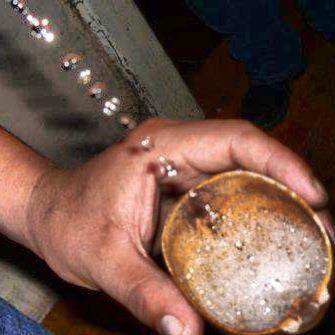
In many communities, mezcal was often made at or above 45 GL (90 proof) because producers lacked precise tools to measure alcohol content. Instead, they relied on visual cues—most notably, the formation of perlas (bubbles), which appear consistently in maguey distillates ranging from 60 GL to 45 GL (120 to 90 proof).
These bubbles are always present, but at higher alcohol content, they appear larger and dissipate quickly. The most stable, fine bubbles typically form between 45 and 60 GL. By the end of the distillation process, the colas (final cuts) have lower alcohol content, and the perlas become extremely fine before disappearing.
Some master mezcaleros can determine the exact alcohol content just by observing the perlas. Some even claim they can recognize the type of agave used just by looking at this phenomenon—can they really?
High-Proof Mezcal: A Matter of Taste, Not Tradition
Anyone who has visited vinatas, fábricas, palenques, or tabernas where mezcal is made may have tasted high-proof distillates that exceed 70 GL (140 proof)—known as mezcales de puntas.
As the Latin adage De gustibus non est disputandum goes, there’s no arguing over taste. We are all free to enjoy what’s in our mezcal glass. What’s not valid is imposing rigid standards on others.
Master mezcaleros, whose ancestral knowledge has been passed down for generations, cannot be wrong. Mezcal made at any alcohol level, as long as it respects traditional or ancestral methods, can be delicious.
The belief that mezcal must never be infused, mixed in cocktails, aged in barrels, or bottled below 45 GL is a baseless myth. These misconceptions have stifled industry growth and limited the creative innovation of skilled artisans who carry mezcal’s ancestral heritage.
The Future of Mezcal: Beyond Tradition
Let’s not forget that the mezcal producers of today—and tomorrow—know how to use an alcohol meter, are educated, well-traveled, and have access to more information than their parents and grandparents ever did.
Lower-proof mezcals offer incredible flavors, allow for higher consumption, reduce costs, and work beautifully in cocktails.
A diverse range of alcohol content is now a reality in mezcal, a Mexican spirit with international prestige thanks to its Denomination of Origin (DO).
 MEZCALEANDO